How to Read the FitSpresso Supplement Facts Label
The Supplement Facts panel is the most reliable information you have about FitSpresso. Here it is in full, line by line, with what each part means and how the amounts compare with research.
Check the Current Price →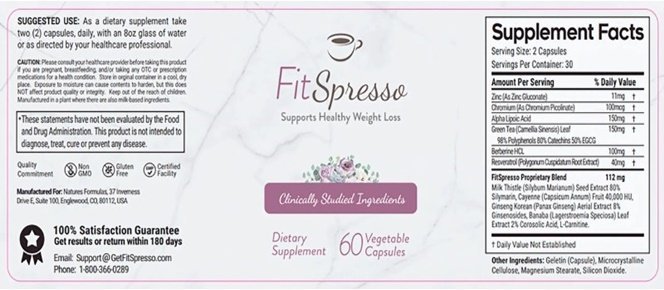
FitSpresso Supplement Facts (transcribed)
Serving size: 2 capsules · Servings per container: 30 · Capsules per bottle: 60
| Ingredient | Amount |
|---|---|
| Zinc (as zinc gluconate) | 11 mg |
| Chromium (as chromium picolinate) | 1,000 mcg |
| Alpha-lipoic acid | 150 mg |
| Green tea leaf extract (98% polyphenols, 80% catechins, 55% EGCG) | 150 mg |
| Berberine HCl | 100 mg |
| Resveratrol (Polygonum cuspidatum root extract) | 40 mg |
| FitSpresso Proprietary Blend: milk thistle seed extract (80% silymarin), cayenne fruit (40,000 H.U.), Korean ginseng aerial extract (8% ginsenosides), banaba leaf extract (2% corosolic acid), L-carnitine | 112 mg total |
Other ingredients: gelatin (capsule), microcrystalline cellulose, magnesium stearate, silicon dioxide.
Suggested use: take 2 capsules daily with an 8 oz glass of water, or as directed by a healthcare professional.
Distributor listed on the label: Nature’s Formulas, 37 Inverness Drive E, Suite 100, Englewood, CO 80112, USA.
Step 1: serving size
All amounts are per 2-capsule serving, not per capsule. One capsule provides half of each amount. A bottle lasts 30 days at the suggested use.
Step 2: the dosed ingredients
| Ingredient | FitSpresso | Used in research | Verdict |
|---|---|---|---|
| Chromium | 1,000 mcg | 200–1,000 mcg/day | Research-level dose |
| Alpha-lipoic acid | 150 mg | 200–1,800 mg/day | Below range |
| Green tea extract | 150 mg (~120 mg catechins) | 141–1,207 mg catechins/day | Low end |
| Berberine HCl | 100 mg | Above 1 g/day for weight | About one-tenth |
| Resveratrol | 40 mg | 10–1,000 mg/day | Low; no weight data |
| Zinc | 11 mg | RDA 8–11 mg | Daily-requirement dose |
Step 3: the proprietary blend
The “FitSpresso Proprietary Blend” lists 112 mg in total for milk thistle seed extract (80% silymarin), cayenne fruit (40,000 H.U.), Korean ginseng aerial extract (8% ginsenosides), banaba leaf extract (2% corosolic acid) and L-carnitine. A blend lists ingredients in descending order of weight but does not give individual amounts, so you cannot compare them with research. The total is small: less than the 150 mg of green tea extract alone.
Step 4: units and standardisation
- mg = milligram; mcg = microgram (one-thousandth of a milligram). Chromium is listed in mcg of elemental chromium.
- “80% catechins” means 80% of the 150 mg extract is catechins, about 120 mg.
- “40,000 H.U.” is the cayenne’s heat rating, a measure of capsaicinoid content.
- “8% ginsenosides” and “2% corosolic acid” describe extract strength, not amounts in the capsule.
Step 5: other ingredients
Gelatin is animal-derived, so FitSpresso is not suitable for vegetarians or vegans, even if some marketing calls the capsules vegetable capsules. Microcrystalline cellulose, magnesium stearate and silicon dioxide are standard fillers and flow agents.
Step 6: what the label does not tell you
- Individual amounts of the five blend ingredients.
- Whether the green tea extract contains caffeine, and how much. See caffeine.
- Third-party testing status.
Step 7: lot number and expiry
Note the lot number and best-before date on your bottle. If you have a problem, the lot number helps the seller investigate. Do not use a product past its date.
Frequently asked questions
What is the FitSpresso serving size?
What is in the FitSpresso proprietary blend?
Who makes FitSpresso?
Is FitSpresso vegan?
Sources
- NIH Office of Dietary Supplements: Chromium (Health Professional Fact Sheet)
- NCCIH (NIH): Berberine and Weight Loss — What You Need To Know
- Linus Pauling Institute, Oregon State University: Lipoic Acid
- NIH Office of Dietary Supplements: Dietary Supplements for Weight Loss (Health Professional Fact Sheet)
- NIH Office of Dietary Supplements: Zinc (Health Professional Fact Sheet)
- Linus Pauling Institute, Oregon State University: Resveratrol